At a glance

Loacker wanted to increase capacity at a location with strict emission standards, continuous monitoring and limited production hours. A new environmental permit required an innovative and reliable solution.

Lybover proposed a three-part filter solution, with maximum reuse of existing components. Thanks to 3D scanning, total station and intensive consultation with the local authorities, the plan was underpinned both technically and administratively.

The project was carried out in phases with minimal downtime. First the wet separator was replaced, followed by the integration of ultrafiltration and activated carbon. A digital tool ensured efficient site monitoring and transparent communication.
Loacker Recycling GmbH is a leading family business that has been active in the recycling sector for over a century. With 1,400 employees spread across eight countries, including Austria, Germany and Switzerland, Loacker processes a wide range of waste streams. From household waste to hazardous waste, from wood to plastics. At their main site in Götzis, close to the border with Liechtenstein, Loacker focuses on the processing of mixed scrap.
Growth within a complex context
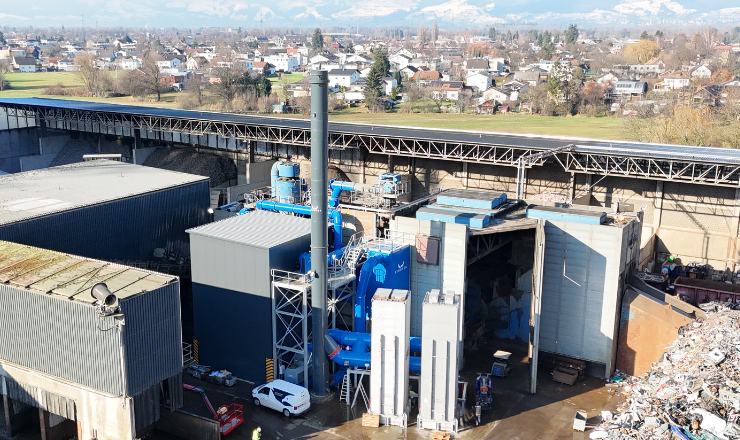
The site in Götzis is equipped with a powerful Lindemann shredder with 2,000 hp. Loacker wanted to increase the capacity of this installation from 80,000 tonnes to 145,000 tonnes per year. An ambitious plan, but the location brought additional challenges. The site is situated near a residential area, which means the local authorities impose very strict dust and VOC emission limits and require continuous monitoring. Due to these ongoing measurements, Loacker was looking for a suitable, reliable and sustainable technology. Emissions must at all times remain below these thresholds, regardless of the shredder input.
A partner who thinks along
Loacker searched for a supplier who was not only technically strong, but also willing to think along with the permit process. The combined technology of ultrafiltration and activated carbon, without any restrictions on the input material, had already been applied successfully in other projects and also proved to be the right choice here.
Lybover took an active role in discussions with the local authorities. Experience and expertise were used to explain the technical feasibility of the solution. Thanks to detailed pre-engineering with 3D scanning, a visit to Lybover and reference visits to similar installations, the authorities agreed to the proposed solution and Loacker was able to start the project with confidence.
Smart phasing, minimal impact
To interrupt production as little as possible, the project was split into two clear phases:
Phase 1: Replacement of wet separator The existing wet separator had been in service for many years and needed to be replaced. Because this component would be harder to access later due to the additional filter steps and to keep production downtime as limited as possible, it was decided to tackle this first. During the two-week summer shutdown, the old wet separator was removed and replaced with a new one, including all necessary structures and connections.
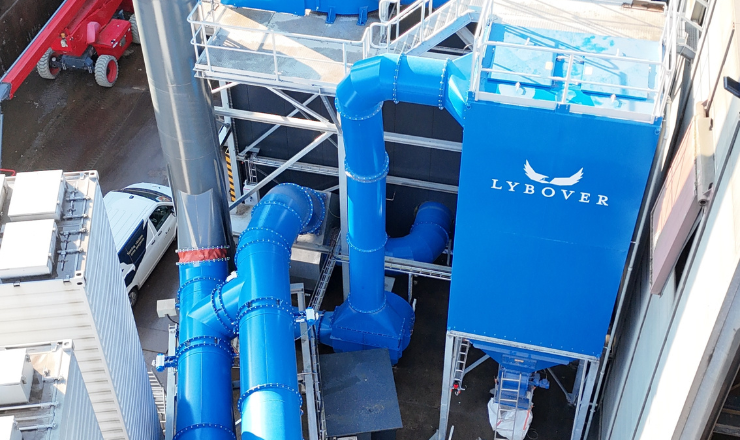
Phase 2: Integration of extra filter steps After the summer, work began on the additional filter steps: ultrafiltration and activated carbon. These were built next to the existing installation. In this way, commissioning could largely take place in advance and the actual production outage for the final conversion was kept to a minimum. Lybover succeeded in integrating the new components with maximum reuse of existing parts. Both the shredder cyclone, sludge tanks, steel construction, shredder fan and a large part of the piping was reused.


Compact design, maximum efficiency
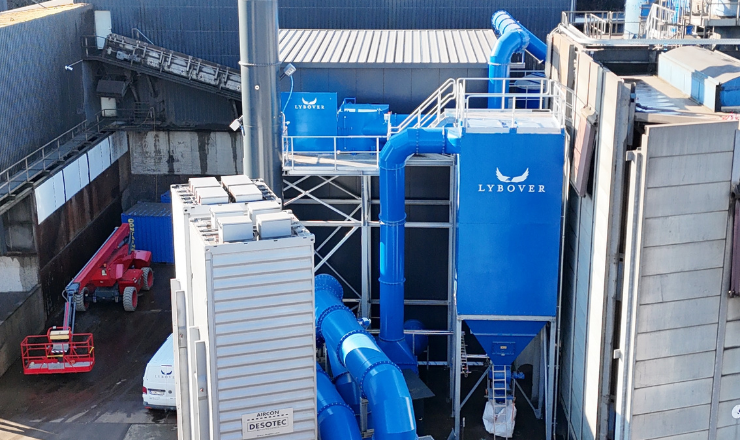
The available space on the site was limited. The new installation had to be compact, attached to an existing building, and remain fully accessible for maintenance and inspection. Thanks to precise 3D scanning, Lybover was able to digitally map the environment and develop a design accurate to the millimetre. Using a total station, the exact positions of the components were set out on site.
After the conversion, the air treatment installation consists of three successive filtration steps:
- Wet system – for the initial coarse capture of all air pollution generated during the shredding process.
- Dry system – for further filtration of finer particles.
- Activated carbon filtration – for the removal of odours and organic components.
In addition, the exhaust air from the separation system and the manual sorting cabin was disconnected from the wet scrubber and connected to a new separate bag filter. By separating the separator, the extraction capacity on the shredder could be increased. Furthermore, the operation of the separator no longer affects the extraction on the shredder (and vice versa), and the energetically optimal solution was developed.
“The strength of this project lay in the collaboration and mutual trust,” says Sander Dewolf, Sales Engineer Projects, AIR. “By bringing all parties to the table at an early stage and communicating transparently each time, we were able to quickly assess technical challenges and work out creative solutions. The result is an installation that perfectly matches both the environment and the ambitions of our client.”
Digital collaboration
During the design phase, a digital tool was used for transparent communication. This tool visualises the latest state of the 3D design together with the executed scan. Both the client and the suppliers can use it to make comments, ask questions and share files. In this way, all changes are automatically documented and efficient collaboration is ensured.
During the assembly phase, this tool is also used for site monitoring. At that moment, the focus is on the structured assembly plan, which has a direct link to the 3D design, and a daily logbook so that the progress can be monitored remotely by the project management.
“Thanks to digital site monitoring, we were able to monitor the progress of the project in detail and communicate rapidly with all partners. The platform gave us real-time insights and ensured that no change was overlooked. As a result, assembly was extremely well-structured and the collaboration remained clear and efficient.” – Lieven Feijtraij, Project Engineer bij Lybover.
A reference that radiates confidence
Loacker opted for a solution that not only complies with the strictest environmental standards, but is also future-proof. Thanks to close collaboration, a complex challenge was transformed into a technical masterpiece. The installation is now running to full satisfaction, with increased capacity and emission levels that remain within the strictest limits.